Fred Wilt
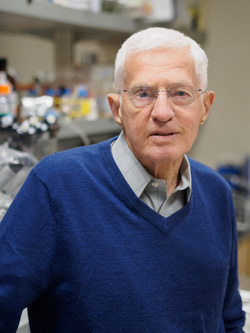
Professor Emeritus of Cell Biology, Development and Physiology

Research Interests
The main interest of the lab is the cellular and molecular basis of biomineralization of the endoskeletal spicule of sea urchin embryos. The developing sea urchin embryo generates four micromeres at its vegetal pole during the fourth cell division. These cells form primary mesenchyme, which in turn forms the endoskeletal spicule of the larva. We have developed methods to isolate and purify the spicules, and characterized the organic matrix of the spicules. It is composed of several glycoproteins. We have isolated cDNA clones from an expression vector library that encodes the principal (glyco)protein of the spicule matrix. We are studying the regulation of the expression of this and related genes and are trying to learn more about how the spicule is differentiated and constructed. Recent work utilizes fluorescent labeling and immunoelectron microscopy to follow the import, precipitation, and secretion of calcium and matrix proteins, which form the spicule. The calcium carbonate is precipitated in the cell as amorphous calcium carbonate, then undergoes exocytosis into a privileged extracellular space where it associates with matrix proteins and undergoes a gradual conversion to crystalline calcite. The molecular mechanisms and genes that undergird these processes are being studied.
Selected Publications
The sea urchin (Strongylocentrotus purpuratus) spicule proteome. [K. Mann, A.J. Poustka, F.H.Wilt, (2010)Proteome Sci. 8:33]
SpSM30 Gene Family Expression Patterns in Embryonic and Adult Biomineralized Tissues of the Sea Urchin, Strongylocentrotus purpuratus. [C.E. Killian, L. Croker, F.H. Wilt (2010) Gene Express. Patt. I0, 135-139]
The Dynamics of secretion during sea urchin embryonic skeleton formation. [F.H.Wilt, C. Killian, P. Hamilton, and L Croker ( 2008) Exp. Cell Res. 314, 1744-1752]
Morphogenesis and biomineralization of the sea urchin larval endoskeleton. [ F.H. Wilt and C.E. Ettensohn (2007) Handbook of Biomineralization (E.Bauerlein, Edit) Wiley-VCH, pp. 183-210]
A genome wide analysis of biomineralization-related proteins in the sea urchin Strongylocentrotus purpuratus.[B.Livingston,C. Killian, F.Wilt et al.(2006) Dev. Biol.
Developmental Biology meets Materials Science: Morphogenesis of biomineralized structures. [F.Wilt ( 2005) Dev. Biol. 280, 15-25]
The transient phase of amorphous calcium carbonate in sea urchin larval spicules: the involvement of protein and magnesium in its formation and stabilization. [S. Raz, P.C. Hamilton, F. H. Wilt, S. Weiner and L. Addadi ( 2003) Adv. Funct. Mater. 13, 1-8]
Photo credit: Mark Hanson of Mark Joseph Studios.
Last Updated 2010-08-11