Diana Bautista
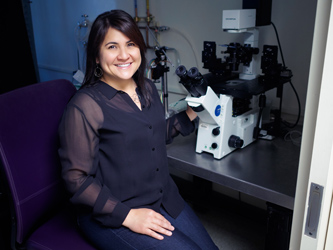
CDP Division Head, Howard Hughes Investigator, and Professor of Cell Biology, Development and Physiology*
**And Affiliate, Division of Neurobiology

Research Interests
Our somatosensory system enables numerous behaviors fundamental to human existence, allowing us to eat, communicate and survive. Acute pain is as a warning signal that alerts us to noxious mechanical, chemical and thermal stimuli, which are potentially tissue damaging. During inflammation or injury, we experience a heightened sensitivity to touch that encourages us to protect the injured site. Despite this essential protective function, pain can outlast its usefulness and become chronic. Numerous pathophysiological conditions result in the chronic dysregulation of mechanosensory signaling, leading to pain triggered by light touch (allodynia), as well as enhanced sensitivity to noxious mechanical stimuli.
Light-touch receptors, which mediate discriminative touch, enables fine tactile acuity that allows us to manipulate objects with high precision. As humans, we depend on this skill for everyday tasks that range from eating with utensils to texting. Discriminative touch is also central to social interactions such as mating, maternal bonding and successful child rearing.
To understand the senses of touch and pain, we must unravel peripheral mechanisms that encode tactile stimuli and discover how the brain interprets these signals to dictate behavior. The transduction of a physical force on the skin into an electrical signal is the first step in the encoding of tactile stimuli. My group uses molecular biology and cellular physiology to discover the ransduction molecules that underlie touch.
Current Projects
We are using multiple approaches to identify the transduction events underlying somatosensation:
I. Developing new cellular assays for the functional analysis of somatosensory neurons.
II. Developing new in vivo assays for analyzing the role of candidate molecules in the detection of light touch
III. Studying the cellular and molecular basis of touch in the star-nosed mole.
IV. Probing the molecular mechanisms of pruritis.
Selected Publications
Pungent agents from Szechuan peppers excite sensory neurons by inhibiting two-pore postassium channels (2008). Bautista DM, Sigal, YM, Tsuruda PR, Milstein AD, Garrison JL, Zorn JA, Nicoll RA, Julius D. Nature Neuroscience, 11(7):772-9
Radial Stretch Reveals Distinct Populations of Mechanosensitive Mammalian Somatosensory Neurons (2008). Bhattacharya MRC, Bautista DM, Wu K, Lumpkin EA, Julius D. PNAS 105(50) 20015-20
TRPA1: Irritant Detector of the Airways (2009). Gerhold KA, Bautista DM. J Physiol. 586(14):330
Molecular and Cellular Mechanisms of Trigeminal Chemosensation (2009) Gerhold KA & Bautista DM. Ann N Y Acad Sci. 2009 Jul;1170:184-9
Mammalian Somatosensory Mechanotransduction (2009) Tsunozaki M & Bautista DM. Curr Opin Neurobiol. 2009 Aug;19(4):362-9
Cellular and molecular mechanisms of pain (2009). Basbaum AI, Bautista DM, Scherrer G, Julius D. Cell 139(2):267-84
Physiological basis of tingling paresthesia evoked by hydroxy-a-sanshool (2009). Lennertz, R, Tsunozaki M, Bautista DM, Stucky, CS. J.Neurosci., 30(12):4353-61
TRPM8, but not TRPA1, is required for neural and behavioral responses to cold temperatures and cold-mimetics in vivo (2010). Knowlton W, Fisher A, Bautista DM, McKemy DD. Pain, 150 (2): 340-350
TRPA1 is required for histamine-independent, Mas-related G- protein coupled receptor-mediated itch (2011). Wilson, SR, Gerhold, KA, Bifolck-Fisher, A, Liu, Q, Patel, K, Dong, X. Bautista DM. Nature Neuroscience, 14(5):595-602
Photo credit: Mark Hanson at Mark Joseph Studios.
Last Updated 2011-08-14