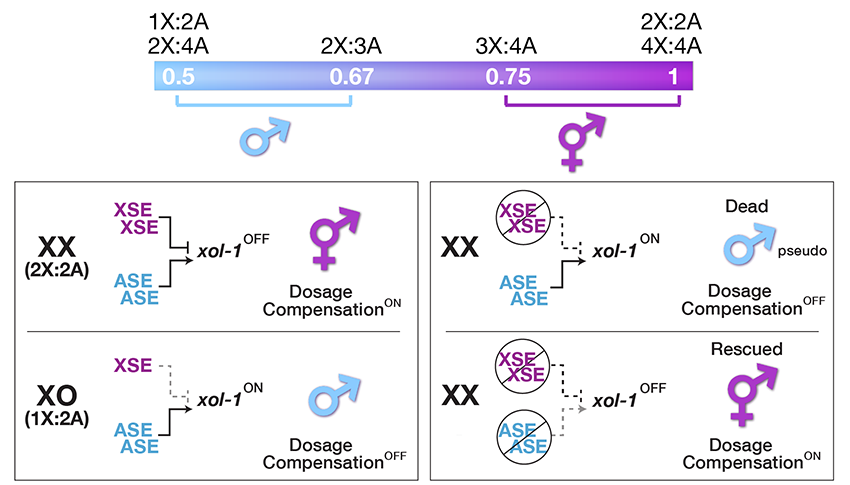
Figure 1. The X:A sex determining signal. (Top), X-chromosome dose is
assessed with high fidelity relative to the ploidy (the sets of autosomes), resulting in
embryos with ratios of 0.5 or 0.67 developing into fertile males, and those with
ratios of 0.75 or 1.0 into fertile hermaphrodites. (Bottom), Genetic properties of
XSEs and ASEs. Genes encoded on X called X-signal elements (XSEs) repress the
master sex-determining gene xol-1, while genes on autosomes called autosomal
signal element (ASEs) activate it. The double dose of XSEs in 2X:2A embryos
counteracts the double dose of ASEs to repress xol-l, thereby promoting
hermaphrodite development and DCC assembly onto X. In contrast, the double dose
of ASEs in 1X:2A embryos counteracts the single dose of XSEs to activate xol-1 and
promote the male fate. Mutations that knock out XSEs in 2X:2A embryos activate
xol-1, causing the masculinization and death of embryos from the disruption of
dosage compensation and the consequent elevation in X-linked gene expression.
Reducing the dose of ASEs in XSE-deficient 2X:2A animals restores the X:A signal,
thereby repressing xol-1 and restoring viability.