Bacterial Pathogenesis
MCB 103/PMB 103/SPH 102/SPH 262
MIDTERM I: February 24, 2005
Professors Dan Portnoy and Matt Welch
1. Define each of the following: (12 points)
a. Bacteriostatic antibiotic
b Antibiotic synergism
Antibiotics work in combination to better prevent growth and promote death of bacteria vs. using one of the antibiotics. It is better to use two synergistic antibiotics b/c it is less likely that the bacteria will acquire resistance to two antibiotics.
Example: b-lactam and aminoglycoside. Aminoglycoside: targets the 30S subunit and b-lactam interfere with cell wall synthesis
c. Activated macrophage
d. Toll-like receptors
Evolutionarily conserved family of receptors. Pattern recognition receptors that recognize common microbial structures referred to as PAMP. Linked by a singnal transduction cascade to transcription of genes involved with inflammation.
e. Cytokine
Signaling protein produced by some mammalian cells in response to stimuli. Mediators of imflammation, septic shock.
f. Adjuvant
A substance that enhances the immunogenicity of an antigen. Critical for vaccine development. Act on APCs via the stimulation of TLRs or other innate immune receptors. Freund’s complete adjuvant: oil and water emulsion plus Mycobacterium (incomplete: no Mycobacterium)
2. Match the following words with their definition (6 points)
__4___ a. auxotroph
__6___ b. psychrophile
__1___ c. microaerophilic
__5___ d. obligate anaerobe
__3___ e. siderophore
__2___ f prototroph
1. Requires reduced oxygen for growth
2. No unusual nutitional requirements
3. Bacterial iron chelator
4. Has mutation causing nutritional requirement
5. Only grows without 02
6. Grows best at low temperature
3. For the following antibiotics indicate if they target: (8 points)
a. cell wall synthesis
b. protein synthesis
c. nucleic acid synthesis
__a___ ampicillin
__b___ streptomycin
__b___ gentamicin
__b___ tetracycline
__c___ naladixic acid
__c___ rifampin
__b___ erythromycin
__b__ chloramphenicol
Questions 4-9; Circle all correct answers (in some cases there may be no correct answer)
4. Which of the following are always true about bacterial plasmids? (5 points)
a. Encode only a few genes (less than ten)
b. Encode antibiotic resistance
c. Specify a pilus
d. Have a broad host range
e. Are essential for growth
5. Which are true about bacterial transposons? (4 points)
a. Often encode antibiotic resistance
b. Generate non-polar mutations upon insertion into an operon
c. Are mobile due to their unregulated insertion
d. RecA-dependent insertion
6. Which of the following may contribute to the regulation of bacterial gene expression?
(5 points)
a. Promoter strength
b. mRNA half-life
c. Ribosome binding site
d. Activators and repressors
e. All of the above
7. Which of the following is true of an operon: (4 points)
a. often includes several genes
b. is considered a global control system
c. is equivalent to a unit of transcription
d. can be regulated by repressors and activators
8. Which of the following are opsonins? (4 points)
a. IgG
b. C3b
c. TNF
d. Defensins
9. Which are true of macrophages? (5 points)
a. Hosts to many intracellular pathogens
b. Can be activated by gamma interferon
c. Short-lived (as compared to neutrophiles)
d. Do not secrete cytokines
e. scavengers
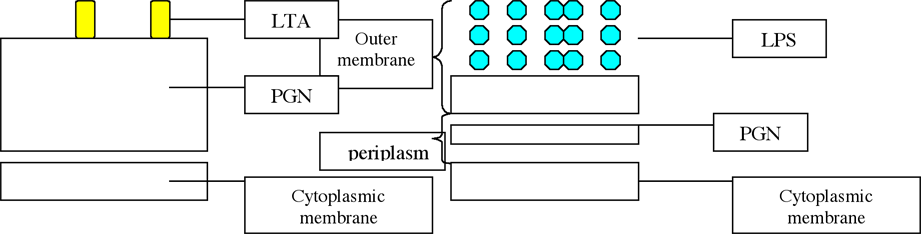
10. Draw pictures of the surfaces of Gram positive and Gram negative bacteria. Include the following components in your picture, where appropriate: cytoplasmic membrane, outer membrane,periplasm, peptidoglycan, lipopolysaccharide (LPS), lipoteichoic acid (LTA). (8 points).
11. List four structural features unique to bacteria that are targeted by the mammalian immune system. (8 points)
CpG DNA (bacterial DNA)
LTA
Lipoproteins
Flagella
Formylated proteins
12. Below is a picture of LPS. Label the three key molecular components, which are delimited by the brackets. Indicate which component of LPS is endotoxin: (8 points).

13. Lysozyme has little effect on the integrity of Gram negative bacteria, but causes lysis of Gram positive bacteria. Briefly explain what lysozyme does, and why it affects Gram positives and negatives differently (4 points).
Lysozyme breaks PGN bonds, resulting in the lysis of Gram positive bacteria but has no effect on gram negative bacteria. Gram negative bacteria have: LPS (preventative barrier), and outer membrane (also preventative) and a small PGN layer (i.e. gram negative bacteria don’t solely rely on a thick PGN layer for cell wall integrity)
14. Clinical isolates are often resistant to multiple antibiotics. What is the molecular explanation? (5 points)
1-Due to transfer of antibiotic resistance genes from other bacteria via transfer of bacterial plasmids
2-Due to acquisition of efflux pumps, which enable the bacteria to pump antibiotics out of the bacterium.
15. Compare and contrast the general secretory pathway and the type III secretory pathway with regard to: t
a. the presence of the pathway in Gram positive and Gram negative bacteria (2 points)
Gram positive bacteria do not have type three secretion systems, whereas both Gram-positive and Gram- negative have general secretory pathways.
b. where secreted proteins are delivered in Gram positive and/or Gram negative bacteria (where appropriate) (2 points).
In general secretion, gram negative and Gram positive bacteria secrete proteins in a similar fashion, however extra secretory components are required in Gram negative bacteria to get the proteins from the periplasm to the outside of a cell.
Gram negative bacteria that have a type III secretory pathways use it in a contact dependent manner in which they directly inject toxins into the host cell which with they have come into contact with.
16a. What are the two components of the two-component system (2 points)?
Sensor kinase/histadine kinase (HK) and Response regulator (RR)
b. which component catalyzes the autophosphorylation reaction (1 point)?
Sensor kinase/histadine kinase (HK)
c. Which component receives the phosphate after the phosphotransfer reaction? (1 point)
Response regulator (RR)
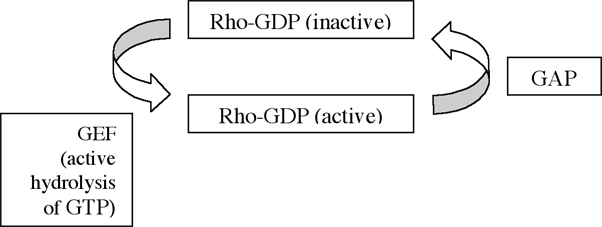
17. Draw the cycle of GTP hydrolysis and exchange by a Rho family GTPase. Indicate what enzymes catalyze the exchange and hydrolysis reactions, and which are the active and inactive forms of the GTPase. (6 points).
18. Complement activation plays a role in combating some Gram-positive infections even though these bacteria are not killed by complement. Explain. (4 points)
Oppsonization-(C3b) resulting in recognition of bacteria by phagocytes via the complement receptor
Oppsonization-(C5a) resulting in chemoattraction of macrophages to bacteria
19. What is the difference between IgG and IgA (location) (4 points)
20. What are the three functions of antibody? (3 points)
1,2-Opsonization and destruction of bacteria via complement or ingestion and digestion of bacteria by phagocytes
3-Neutralization of toxins
21. Name a one key characteristic that can be used to distinguish between compartments involved in phagocytosis (endosome, multivesicular body, late endosome, lysosome), and briefly describe how it differs in the different compartments (6 points)
1-morphology
2-pH, early: 6.5, late: 5.5-6, phagolysosome: 4.5-5
3-RAB proteins: immunofluorescence
4-SNARE proteins: immunofluorescence
5-Proteases
22. C3H/HEJ mice lack a functional Toll-like receptor 4 (TLR4) that is known to recognize Lipid A.
Would you expect these mice to be more or less resistant to endotoxic shock upon iinoculation with purified LPS? (3 points)
More resistant
b. Would you expect these mice to be more or less resistant to infection with Gram-negative bacteria? Explain. (3 points)
Less resistant because TLR4 recognizes lipid A, a component of the cell wall in Gram-positive bacteria
c. What about Gram-positive infection? (3 points)
No difference
23. Spontaneous streptomycin resistance occurs at a frequency of 10-8.
a. How many bacteria would you need to plate to achieve 100 colonies on agar medium containing streptomycin (2 points)
1010
b. Streptomycin resistant bacteria are often avirulent. Why? (2 points)
24. Transposon mutagenesis identifies a potential determinant of pathogenesis. Upon DNA sequencing of the surrounding region, you note that the G+C ratio of the DNA surrounding the mutated gene is significantly different that the average G+C content of the bacterium. What might this suggest, and what other clues might you look for to support your hypothesis? (4 points).
Increase in G+C content indicates that the region the transposon mutated is a pathogenicity island. This region may be a pathogenicity island if the region is absent in non-pathogenic strains; if it is inserted into a tRNA site or duplicated gene; if it is presense of known or susceptibility virulence genes or if it is associated with mobile DNA elements.
25. An E. coli donor contains a plasmid, temperature-sensitive for replication. The plasmid encodes tetracycline resistance and also contains TnphoA encoding kanamycin. The recipient is resistant to streptomycin. Assume that conjugation frequency is 10-2 and transposition frequency is 10-4. Conjugation is allowed to proceed with 109 recipients mixed 1:1 with 109 donors.
a. How many colonies do you expect on (8 points)
__109___ Streptomycin plates at 30C
__107___ Streptomycin and tetracycline at 30C
__107___ Streptomycin and kanamycin at 30C
__103___ Streptomycin and kanamycin at 40C (non-permissive temperature for plasmid
replication)
b. What percentage of random TnPhoA insertions would you predict result in a secreted fusion protein? State assumptions. (6 points)
1/6 insertions is functional (in-frame insertion and must be in correct orientation)
If 10% of the proteins in a bacterium are secreted.
Math: 1/6(1/10) X 100=1.7%